

The ESG fork in the road
In today’s climate, too many businesses still mistake sustainability reporting for action. A GRI topic here, a nod to the UN SDGs there – just enough to meet the letter of regulation, but rarely its intent.
While pragmatic, this approach fails to consider broader sustainability dependencies, impacts and opportunities. Compliance without clarity is becoming increasingly costly and visible to investors and stakeholders. The reluctance to adopt a holistic view of sustainability performance also undermines credibility, constrains market visibility and erodes long-term profitability.
As momentum and market share increasingly go hand in hand, the companies pulling ahead are those that understand their performance in context: managing risk across their full operating footprint and responding to wider societal expectations with strategic intent. It’s the generation of comparable, assured sustainability data that reduces information risk, improves access to capital and clarifies where value is created, preserved and innovated.
For forward-thinking companies willing to move beyond ESG tick-box compliance and embrace strategic storytelling, CSRD offers far more than a reporting obligation. When woven meaningfully throughout corporate reporting, it becomes a powerful framework for reinforcing purpose, performance and long-term belief, turning sustainability disclosure into a source of competitive differentiation. Used well, CSRD demonstrates both clearly and credibly how businesses create value, manage risk and lead responsibly in a changing market.
Crucially, the most effective approaches aren’t driven by compliance alone, but by intent. In doing so, they point to a broader shift in corporate reporting: where leading companies aren’t distinguished by their ability to satisfy frameworks, but by how effectively they use them to articulate a coherent, credible and compelling narrative of value creation.
Many companies began their ESG journey with the United Nations Sustainable Development Goals (UN SDGs) – inspirational, global and high level. Many then moved onto the Global Reporting Initiative (GRI), selecting topics that best suited their sector, story or stage of maturity.
But without consistency or comparability, these frameworks often left stakeholders wondering: What’s the sustainable truth? Is this story credible?
Then came the International Sustainability Standards Board (ISSB) and the International Financial Reporting Standards, IFRS S1 and S2, elevating ESG reporting into the realm of investor-grade disclosure. A critical step, and one that forms the basis for the UK’s own Sustainability Reporting Standards, SRS1 and 2, finalised in February 2026 and forming the basis of the UK’s forthcoming sustainability disclosure regime. It is, however, focused primarily on single financial materiality.
Here, the EU’s Corporate Sustainability Reporting Directive (CSRD) goes further. It builds on what came before, but widens the lens to offer structure alongside strategic coherence. It’s not just a framework. It’s a storytelling superpower.
Europe’s new reporting directive may seem like a burden. It’s actually an opportunity.
CSRD: Mandatory disclosure, strategic vision
The CSRD aims to reshape sustainability, taking it from the margins of reporting to become its cornerstone.
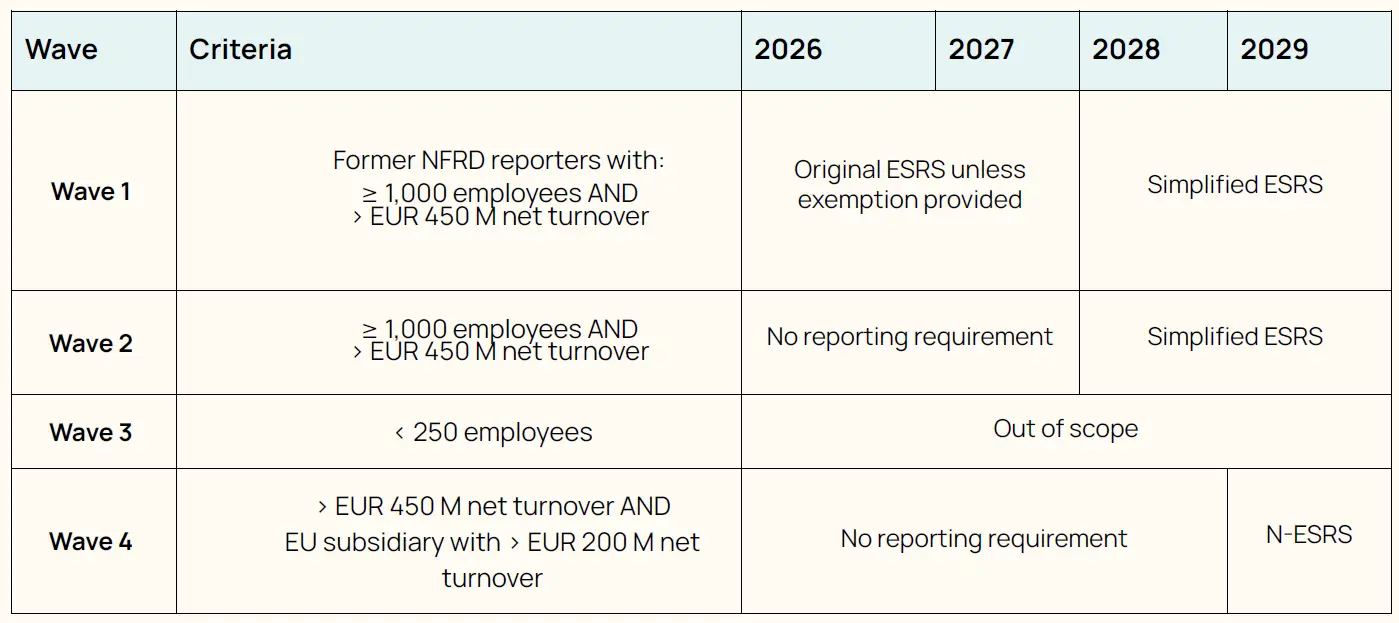
However, the introduction of the EU’s Omnibus I simplification package, published on 26 February 2026 and in use from 18 March 2026, has shifted the immediate regulatory landscape. By narrowing CSRD’s scope and delaying reporting requirements for many companies, the directive has reduced the number of organisations directly in scope, particularly across UK-listed entities.
But this isn’t a retreat from sustainability reporting. It’s a recalibration of scope, not of expectation.
The most forward-looking businesses aren’t asking whether CSRD applies. They’re asking what it reveals. Because, while regulatory obligation may fluctuate, the underlying demand from capital markets for comparable, assured and decision-useful sustainability data continues to intensify.
And it’s here that CSRD introduces a new era of comparable, complete and credible sustainability disclosure.
The framework offers more than a compliance tool. When applied with strategic intent, CSRD becomes a foundation for investability, enabling organisations to tell a story that’s understandable, supported by evidence and focused on the future. It allows stakeholders to see what you do and what you stand for.
Described by many as a “watershed moment” for ESG, CSRD demands:
Double materiality - What affects your business, and what your business affects. It requires reporting on both environmental and societal risks to the company and impacts from the company.
Value chain transparency - Beyond your own walls. CSRD extends reporting to upstream suppliers and downstream usage, forcing companies to map influence, and identify and manage hidden risk across the value chain ecosystem before it surfaces.
Stakeholder breadth - It’s not just about investors. It’s about building reputational credibility with wider stakeholders and regulators who are increasingly intolerant of greenwashing – a signal that stakeholder capitalism is no longer just a philosophy, but policy reality.
It already applies to large EU-based firms previously subject to the Non-Financial Reporting Directive (NFRD). However, following the EU’s 2026 Omnibus Directive, the scope and timing of CSRD disclosures have been recalibrated, narrowing the number of companies directly in scope, particularly among non-EU entities.
While this reduces immediate regulatory exposure for many UK businesses, it doesn’t diminish the broader expectation – companies operating across European markets will provide clear, comparable and decision-useful sustainability information to investors and stakeholders.
CSRD: The strategic upside
With the publication of the UK Sustainability Reporting Standards (UK SRS S1 and S2), aligned to IFRS, the direction of travel is clearer than ever: sustainability disclosure is becoming more tightly connected to financial reporting, governance and capital market expectations.
In this context, the question is no longer whether companies are formally in scope for CSRD; it’s whether they’re equipped to deliver clear, comparable and assured sustainability information to investors and stakeholders.
And the commercial case for doing so is only strengthening:
Morgan Stanley’s 2025 Sustainable Signals research found that 88% of surveyed companies now view sustainability as a long-term value creation opportunity, with more than 80% reporting that they can measure return on investment from sustainability-related initiatives.
Anthesis’s 2025 Cost of Silence report adds a sharper warning: companies with strong environmental performance can see up to 6% higher EBITDA than their peers, yet a significant proportion still either under-report or remain silent on their sustainability progress, which erodes trust and provides missed opportunities.
The implication is clear: the cost of delay is no longer just reputational. It’s strategic.
While UK SRS will anchor sustainability within financial materiality and investor-grade disclosure, CSRD continues to offer something broader: a framework for understanding how value is created, preserved and exposed to risk across the full value chain.
In short, CSRD doesn’t just ask for disclosure. It demands definition.
And for companies willing to engage with it on these terms, it remains a powerful lever for insight, differentiation and long-term resilience.
Double materiality: Aligning risk, impact and value
CSRD’s greatest challenge is also its greatest asset: double materiality. By identifying key material ESG factors, the disclosures enhance long-term decision making and build deeper resilience by surfacing the wider material risks likely to impact a company’s performance. Better data builds better credibility with investors, markets and the public by:
Identifying and managing the hidden risks in your value ahead of time.
Unlocking innovation, especially in circularity, product design and customer expectations.
Building reputational credibility and ambition with talent, regulators and investors who are tired of greenwashing or hushing spin.
CSRD provides the data backbone to make sustainability storytelling visible and believable. This is where evidence meets emotion – trust grows when performance data is paired with strategic clarity and human relevance.
This is not bureaucratic overreach. It’s the architecture of long-term value creation.
Case in point: Kenmare Resources
Kenmare Resources plc is a small-cap miner operating on the north-east coast of Mozambique. A company focused on the extraction of ilmenite, a titanium bearing mineral, it’s a key global producer of titanium feedstocks and zircon. It aligns its operations with local impact, building sustainable performance and transparency into its value creation.
In 2024, Kenmare adopted CSRD ahead of its peers and EU compliance timelines, seeing its opportunity to lead. The company responded to CSRD as a reporting requirement alongside a strategic brief, collecting the necessary data for ESRS alignment and embedding it across the architecture of the report. They took a bold step: they moved beyond the production of a functional sustainability statement to combine, elevate and index CSRD compliance within their wider annual report’s content.
The result was a report that was compliant, compelling and award winning for its integrated storytelling. Judges commended its excellence as an early example of a small-cap adopter of CSRD, citing its: “purpose-led narrative” and “innovative way of implementing CSRD into strategy”. Every metric, visual and materiality map was designed for auditors, communities, analysts and capital markets. It proves how CSRD, when applied creatively, doesn’t constrain the story. It amplifies it.
The latest evolution reveals something more nuanced. Kenmare has begun to rebalance how and where CSRD is integrated into its storytelling. Explicit tagging within core sections like the business model and value chain have been removed; in their place, a more considered architecture is emerging. Narrative flows more freely, while ‘read more’ guides readers to detailed, connected CSRD disclosures housed elsewhere. The effect is subtle but significant: compliance is no longer embedded everywhere, but remains accessible everywhere.
This marks a shift from visibly mapping compliance to deliberately shaping it. From embedding disclosure within every page, to integrating it into clear connective pathways, Kenmare has moved from auditor-led structuring to editorially controlled storytelling – a recalibration that reflects how the most sophisticated reporters don’t remove the framework, but reshape how it lives within the narrative.
The opportunity cost
Let’s play out the “we’re not in scope” inertia strategy to its logical end.
You invest the bare minimum in sustainability disclosure. You delay building the data architecture. You wait to see how peers meet the new UK requirements. Meanwhile, your next reporting cycle is already in motion, and the gap between what you’re producing and what capital markets are starting to expect is widening.
Investors are asking sharper questions. Ratings agencies are noticing the gaps. Competitors, some of them your peers on the same indices, are publishing reports aligned with double materiality that make yours look thin by comparison. And the reputational distance isn’t just visible to analysts. It’s visible to the talent you’re trying to hire, the regulators reviewing your sector and the partners deciding who to work with.
As Kenmare’s example already demonstrates, the companies moving first aren’t just more compliant. They’re more coherent. Their reports read as strategic documents, not regulatory filings. And that coherence, the ability to connect sustainability performance to business value in a way stakeholders actually believe, is becoming a competitive differentiator in its own right.
Waiting isn’t caution. Waiting means that, by the time you move, someone else has already defined what good looks like. And you’re trying to catch up, not lead.
What your next annual report needs to do differently
If you’re a UK Plc preparing your next annual report or sustainability report, the question isn’t whether to engage with CSRD or UK SRS in the abstract. It’s whether the next report going to market is equipped to meet the expectations already forming around it.
This is where the gap becomes visible.
Some organisations are still operating at a TCFD + GRI level. Structured, but selective. Others are beginning to map double materiality but are struggling to integrate it into a coherent narrative. A smaller number are moving ahead and building reports that are compliant, credible, connected and decision useful.
The difference isn’t intent. It’s execution. So, what actually needs to change?
Integration across the narrative, alongside its dedicated section
Sustainability can no longer sit in isolation. It needs to be structurally connected to strategy, risk, governance, metrics and capital allocation, not as an overlay, but as part of how the business explains itself. At the same time, the data must remain navigable and accessible for those who need to interrogate it directly. The challenge isn’t choosing between integration and clarity. It’s delivering both.
Double materiality as a strategic lens
Even where not mandated, the expectation is forming. As the UK SRS establishes a framework for financial materiality, investors and analysts are looking beyond to impact materiality and its quantitative role in financial resilience and strategic performance. Stakeholders are looking for clear signals that companies both understand what affects their performance, and how their activities create an impact across the system they operate in. This is what shifts a report from defensive disclosure to strategic articulation.

Assurance readiness
The direction of travel is clear. What is disclosed will increasingly need to be assured. Audit committees are already asking uncomfortable questions about data provenance, controls and consistency. If sustainability data cannot withstand the same scrutiny as the financials, the credibility of the entire report is at risk. Building the right infrastructure and internal controls cannot be left to the final stages of the reporting cycle. The time for action is before the auditors arrive, not after.
Value chain visibility
CSRD’s requirement to map upstream and downstream impacts isn’t bureaucratic overreach. It’s financial risk mitigation. For many organisations, this is where the greatest hidden exposure sits. Understanding upstream dependencies and downstream impacts is no longer a theoretical exercise. It is fundamental to risk management, resilience and the ability to demonstrate long-term value creation.
Storytelling to shape belief
This is where everything converges. The most effective reports, including Kenmare’s, are those where data, governance and materiality align to tell a coherent story. Where the reader doesn’t just understand what’s been disclosed, but why it matters. That’s the difference between formal compliance and capital market belief.
Using both lenses
If CSRD represents the most expansive view of sustainability, the UK’s Sustainability Reporting Standards (UK SRS) represent its financial core. Based on IFRS S1 and S2, the UK SRS signals a clear direction: tighter integration between sustainability and financial reporting, with a focus on investor-grade disclosure.
In a post-Omnibus environment, this matters. Because, while fewer UK companies may be formally in scope for CSRD, all will be expected to deliver clear, comparable and assured sustainability information to capital markets, whether mandated by regulation or demanded by investors.
Therefore, the smart approach is no longer “CSRD or UK SRS?” It’s using both as complementary instruments. UK SRS to anchor financial materiality, governance and investor-grade disclosure. CSRD principles to expand visibility across value chains, impacts and long-term risk. Together, they form a more complete picture of business resilience, and a more compelling report.
Translating that into a document that actually works – one that satisfies regulators, persuades analysts and earns trust from the wider stakeholder base – requires more than good intentions. It requires the right data architecture, narrative structure and ability to make complex, cross-cutting information feel coherent rather than overwhelming. That’s not just a reporting challenge; it’s a storytelling challenge. Increasingly, the companies getting it right are the ones who treat the annual report as both a compliance output and their most important strategic communication.
The future belongs to credible storytellers who inspire where and how stakeholders invest
Behavioural science tells us people judge credibility on two levels: does it make sense, and does it feel right. The best sustainability reporting delivers both by combining evidence, structure and human relevance in a way stakeholders can believe.
CSRD may no longer apply to everyone. But the thinking behind it – integrated, assured and value chain aware – is fast becoming the benchmark. And the companies that embed it into their compliance processes and the architecture of how they report and communicate, as Kenmare have done, will earn something more durable than regulatory approval.
They will earn belief.
And in a capital market – where trust is the scarcest resource – belief is what converts disclosure into value, and value into advantage.
Every organisation's reporting journey is different. If you're thinking about how your next report can create greater understanding, build confidence and inspire belief, we'd love to help.
Sources
Aishwarya Shukla (2025). Breaking New Ground: A Retrospective on Sustainability Reporting in 2024 https://www.esgbook.com/insights/research/breaking-new-ground.
Anthesis Group (2025). The cost of silence https://www.anthesisgroup.com/me/insights/the-cost-of-silence-2025/.
Council of the European Union (2026). Council signs off simplification of sustainability reporting and due diligence requirements to boost EU competitiveness https://www.consilium.europa.eu/en/press/press-releases/2026/02/24/council-signs-off-simplification-of-sustainability-reporting-and-due-diligence-requirements-to-boost-eu-competitiveness/#:~:text=Corporate%20sustainability%20reporting%20directive,burdens%20of%20due%20diligence%20processes.
CSRD Institute (2026) csrdinstitute.eu.
European Union Legislative Acts (2026). DIRECTIVE OF THE EUROPEAN PARLIAMENT AND OF THE COUNCIL amending Directives 2006/43/EC, 2013/34/EU, (EU) 2022/2464 and (EU) 2024/1760 as regards certain corporate sustainability reporting requirements and certain corporate sustainability due diligence requirements https://data.consilium.europa.eu/doc/document/PE-66-2025-INIT/en/pdf.
European Union: Official Journal of the EU (2026). Directive (EU) 2026/470 of the European Parliament and of the Council of 24 February 2026 amending Directives 2006/43/EC, 2013/34/EU, (EU) 2022/2464 and (EU) 2024/1760 as regards certain corporate sustainability reporting requirements and certain corporate sustainability due diligence requirements (Text with EEA relevance) https://eur-lex.europa.eu/eli/dir/2026/470/oj.
IFRS (2024–25). Webinar series – Perspectives on sustainability disclosure https://www.ifrs.org/sustainability/knowledge-hub/webinar-and-podcast-series/.
Kenmare Resources (2024). Annual report and CSRD case study.
Kenmare Resources (2025). Annual report and CSRD case study.
Morgan Stanley (2025). Companies see sustainability as a way to create value https://www.morganstanley.com/insights/articles/corporate-sustainability-signals-report-2025.
Morgan Stanley (2025). Sustainable Signals: Corporates 2025 https://www.morganstanley.com/assets/pdfs/MS_Institute_for_Sustainable_Investing_Sustainable_Signals_Corporate_report_2025.pdf.
Morgan Stanley (2025). Sustainable Signals: Individual Investors 2025 https://www.morganstanley.com/content/dam/msdotcom/en/assets/pdfs/2025_Sustainable_Signals_Individual_Investors_2025_report.pdf.
Reuters (2024). Comment: ‘Europe’s new reporting directive may seem like a burden, it’s actually an opportunity’ https://www.reuters.com/sustainability/sustainable-finance-reporting/comment-europes-new-reporting-directive-may-seem-like-burden-its-actually-an-2024-02-22/.
The Wall Street Journal (2025). Scaling and streamlining sustainability reporting in an effort to drive growth https://deloitte.wsj.com/cfo/scaling-and-streamlining-sustainability-reporting-in-an-effort-to-drive-growth-1908eecb.
UK Government (2025). Exposure drafts: UK Sustainability Reporting Standards https://www.gov.uk/government/consultations/exposure-drafts-uk-sustainability-reporting-standards/exposure-draft-of-uk-sustainability-reporting-standards-uk-srs-s1-and-uk-srs-s2.
Watershed (2026). How to navigate the CSRD in 2026: Expert advice for companies https://watershed.com/en-GB/events/csrd-2026-omnibus.

